Driving sustainable Application Development success through data-driven insights.
The End of “Hours for Hire” – Welcome to Output-Based Agile Contracting
For decades, the IT industry has tolerated a toxic contracting model: Time & Materials (T&M) for (agile) application development based on hourly rates. Vendors bill for effort, not outcome. Clients pay for bodies, not value. And when procurement forces competition on price alone, the old proverb rings true: “If you pay peanuts, you get monkeys.” The result? Misaligned incentives, endless scope creep, zero accountability for performance, and projects that drag on while budgets vanish. It’s an industry bad practice we’ve all lived with—until now.
4 min read


The Problem with “Effort = Value”
In traditional T&M contracts:
Suppliers are paid to show up and log hours, not to deliver working software.
There’s no link between cost and business value.
Teams have zero skin in the game for velocity, quality, or customer satisfaction.
Procurement selects the cheapest rate, often sacrificing skill, reliability, and long-term performance.
This isn’t collaboration—it’s commodity labour trading. And it fails both client and supplier.
NPR 5333: A Standard Built by Industry, for Industry
That’s why a consortium of leading Dutch organizations, frustrated with broken incentives, partnered with the Dutch Standardization Institute (NEN) to create NPR 5333: Guideline for Output-Based Measurement, Performance Management, and Contracting of Agile Teams. Our very own Harold van Heeringen, founder of AgileBenchmark, was a contributor to this standard. His decades of experience in agile benchmarking, functional sizing, and performance metrics helped shape a framework that finally aligns payment with delivered value. And here’s the best part: NPR 5333 is free to use for the next 5 years, thanks to forward-thinking sponsors who believe better contracting benefits the entire industry.
How NPR 5333 Works: Measure What Matters
NPR 5333 shifts the focus from input (hours) to output (functionality delivered) and proposes metrics over 4 axes:
Faster: e.g., Delivery Speed (FP per month), Flow Predictability (FP delivered FP committed)
Cheaper: e.g., Cost Efficiency (Cost or price per FP)
Better: based on the ISO 5055 standard, e.g., Maintainability, Efficiency, Reliability, Security of the code
Happier: e.g., team happiness, user happiness, and cooperation happiness.
The NPR proposes a base set of 27 metrics across 4 axes, but it is up to each organization to create a set of metrics with its supplier(s) that everyone is comfortable with. In the end, the main goal is to have a pricing mechanism based on functionality delivered: a price per function point. This is a win-win: when a supplier is more productive, their margin on the contract is higher, while the customer pays for delivered value rather than hours burned.
This creates true accountability. Suppliers are rewarded for efficiency and quality. Clients pay for business outcomes, not attendance.
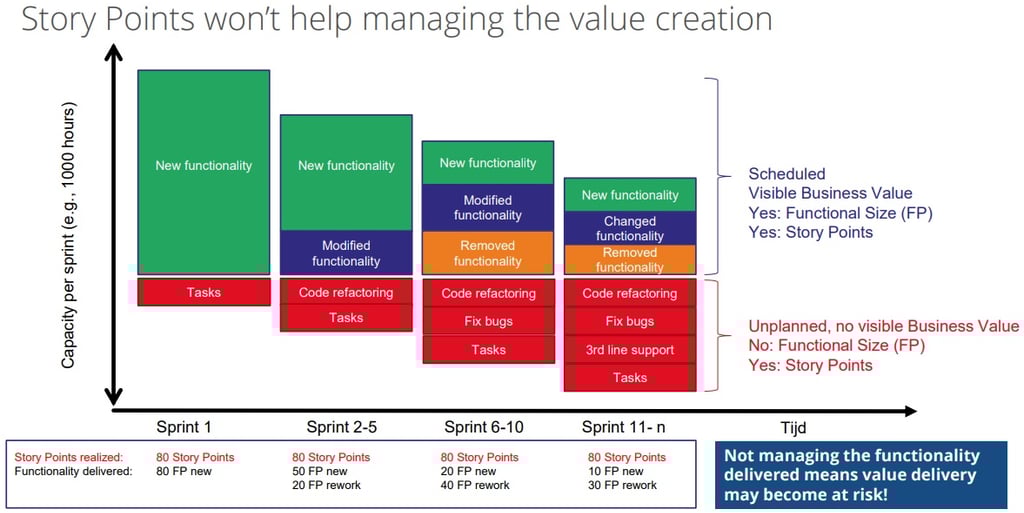
Especially when it comes to contracting, it’s important to use standardized metrics in contracts that can be audited, when necessary, by an external party. This excludes story point metrics, as these are not standardized and also are not directly related to value (functionality) delivered, as the following figure shows.
Figure 1: The agile team capacity spent per sprint, the value produced and the difference between FP and SP.
The figure shows that agile teams have a fixed capacity of X hours per sprint (on the y-axis, in this example, 1000 hours), and they need to do many things with these hours: create new functionality, but also tasks, bug fixing, rework, etc. Creating value (add, modify, or even delete functionality) is something the customer or the user sees in their application, while other activities like tasks, rework, etc., are not visible to them. The team will assign story points to anything that costs effort; however, that is what story points are for. It’s a subjective measurement of effort instead of an objective measurement of size. There is a fundamental difference. In the example, for instance, the predictability is story points is very good over time (80 SP per sprint), while the amount of new value (functionality) is decreasing over time. Management looking at Story Point dashboards may think that everything is under control, while in practice, the team really suffers from decreasing productivity and is struggling to deliver value to the customer.
The Perfect Enabler: Nesma Easy Functional Sizing (EFS)
To make this practical in agile environments, Nesma has just released Easy Functional Sizing (EFS)—a lightweight, sprint-friendly method to measure delivered functionality in under 10 minutes per sprint. No more complex counting rules. No more estimation theatre. With EFS:
Product Owners and teams size user stories in standardized units during refinement and/or in the retrospective.
Functionality becomes measurable, comparable, and contractually enforceable.
Metrics like Cost Efficiency (€ per Function Point) or Delivery Speed (FP per month) become real, actionable KPIs.
EFS + NPR 5333 = the operating system for output-based agile contracting.
Why AgileBenchmark Is Your Ideal Partner
At AgileBenchmark.com, we didn’t just watch this standard emerge—we helped build it. With deep expertise in:
Agile team performance benchmarking (using ISBSG, Nesma, and proprietary data).
Functional sizing (we’re certified in COSMIC, Nesma, and now EFS).
IT sourcing & contracting strategy support.
KPI design and dashboarding.
Application Development measurement and metrics.
We are uniquely positioned to help you transition from T&M chaos to NPR 5333 excellence. Whether you’re a client wanting fair, outcome-driven contracts or a supplier ready to differentiate on performance, we’ll guide you with:
NPR 5333 readiness assessments
Assessment of current contracts and Hourly rates Benchmark
Best Practices Adoption and Maturity Assessment
Setting realistic KPI targets per team and contract
Create a complete output-based contract NPR5333-proof
EFS training and rollout for your teams
Benchmarking your metrics vs. industry peers
Baseline measurements and continuous measurements
Implementation of automated data collection, measurements and dashboards.
Contract templates and KPI frameworks
Ongoing coaching and support
We guarantee your success and won't stop until you are satisfied with the results!
It’s Time to Contract for Value, Not Hours
The era of paying for effort without evidence is over. NPR 5333 + Easy Functional Sizing gives you the tools. AgileBenchmark gives you the expertise. Stop rewarding presence. Start paying for performance.
Contact us today for a free NPR 5333 readiness scan and learn how to restructure your agile contracts around real, measurable value. Check the Contracting Services (NPR 5333 ) page here: link and/or Subscribe to the AgileBenchmark.com newsletter for weekly insights, benchmark reports, and expert tips delivered to your inbox: link.
We also have a great temporary offer to implement the Agile Value Governance System (AVGS) for 1 of your contracts/teams/vendor at a huge DISCOUNT now. Interested? Check here: https://agilebenchmark.com/avgsoffer Here you can also book a free half-hour meeting to see how we can help you Pay for Value instead of for people showing up.
EFS sizes the value. NPR 5333 enforces it. AgileBenchmark makes it happen.