Driving sustainable Application Development success through data-driven insights.
How Software Cost Estimation Saves You Money!
11/13/20254 min read


The Pitfall of Human Judgment: Why Optimism Wins (and Loses)
Let's face it—most software project estimates start with human judgment methods, like expert opinion, analogy, or gut feel. These are quick, intuitive, and feel collaborative. But here's the harsh truth: they've been proven to be overly optimistic. Research from the Standish Group’s CHAOS reports and the Software Engineering Institute (SEI) shows that human-based estimates underestimate effort by 20-50% on average. Why? Cognitive biases like optimism bias (we assume the best-case scenario), anchoring (basing estimates on initial, vague ideas), and the planning fallacy (underestimating complexity) play a huge role.
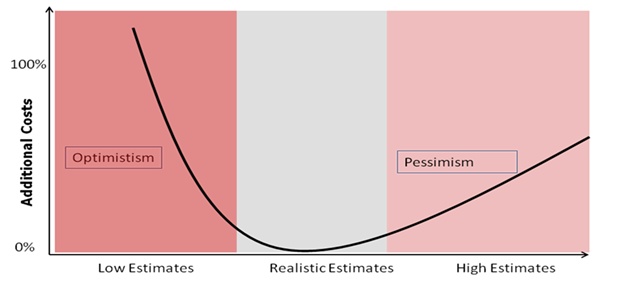
The result? Optimistic estimates always end up in overruns. A project quoted at 6 months stretches to 9, with costs ballooning 30-100%. Steve McConnell describes in his book “Software Cost Estimation -demystifying the black art” the effect as shown in the next figure: optimistic estimates will run into non-linear additional costs and schedule (overruns). Pessimistic estimates, however, run into ‘Parkinson’s law’, which states that if you give someone or a team extra time to complete a task, they will use that time. This means that pessimistic estimates result in successful projects as well as realistic estimates, but it could have been done cheaper and/or faster.
Figure 1: The effect of optimism, realism, and pessimism on the project outcomes.
Teams scramble with scope creep, rushed code leads to bugs, and rework eats into profits. Pizza boxes pile up in the hallways, as working overtime becomes the standard ‘to meet the schedule’. In agile environments, this manifests as velocity inconsistencies, unfinished sprints, and eroded trust. If your organization is still "winging it" with judgment alone, you're gambling with your budget.
Enter Software Cost Estimation: A Data-Driven Superpower
Software Cost Estimation isn't guesswork—it's a formal, evidence-based process that uses:
Functional Size Measurement (FSM): Quantifies the software's functionality independently of technology or effort. Tools like Function Point Analysis (FPA) or COSMIC measure user requirements in standardized units (e.g., function points), providing an objective "size" of the project. Nesma recently launched the ‘Easy Functional Sizing’ method, with very few rules, that can be easily learned and is targeted at agile teams to use formal metrics next to the methods they already use.
Relevant Historical Data: Draws from your organization's past projects (or industry benchmarks, e.g., ISBSG data repositories) to calibrate estimates. No more reinventing the wheel—learn from what actually happened last time.
Proven Parametric Models: Algorithms like COCOMO II, SLIM, TruePlanning or SEER-SEM use mathematical formulas to predict effort, duration, cost, and risks based on size, complexity, team skills, and constraints. These models simulate different scenarios (e.g., "What if we add two more developers?" or "How does remote work impact the timeline?").
This trio creates parametric estimates that are repeatable, auditable, and far more accurate—often within 10-20% of actuals, per benchmarks from the International Software Benchmarking Standards Group (ISBSG).
An example: Imagine estimating a new e-commerce platform: FSM sizes it at 1,200 function points. Historical data shows your team averages 15 points per person-month. The parametric model factors in risks and outputs scenarios: base case (8 months, $450K), aggressive (6 months, $520K with overtime risks), or conservative (10 months, $480K).
No optimism bias—just facts.
Beyond Prediction: Advantages for Monitoring and Stakeholder Communication
Formal estimates aren't just for kick-off—they're a living tool throughout the project lifecycle.
1. Superior Project Monitoring
Earned Value Management (EVM) integration: Track progress against planned costs and schedule using function points as "earned value." Spot variances early—e.g., if only 40% of functionality is delivered at 60% budget spend, intervene before it's too late.
Agile-Friendly: In Scrum or Kanban, re-estimate remaining work with updated FSM and models at each sprint. This maintains accurate burn-down charts and prevents "velocity inflation."
Risk Mitigation: Parametric models highlight sensitivities (e.g., "A 10% requirements change adds 15% cost"). Monitor these in real-time to avoid surprises.
2. Clearer Stakeholder Communication
Defensible Numbers: Back estimates with data, not opinions. Stakeholders see scenarios side-by-side, fostering buy-in. "Here's why we need 8 months—and the trade-offs for rushing."
Transparency Builds Trust: Share dashboards showing historical benchmarks vs. current progress. Executives love the audit trail for governance and compliance.
Alignment Across Teams: Developers, PMs, and clients speak the same language—function points over vague "story points." Reduces misunderstandings and scope debates.
In one case study from ISBSG, a financial services firm using parametric estimation reduced overruns from 45% to under 10%, saving $1.2M on a $5M portfolio.
Ready to Stop Overruns and Start Saving? Trust Certified Expertise!
The choice is clear: cling to optimistic guesses and watch budgets evaporate, or adopt Software Cost Estimation backed by rigorous standards, historical precision, and parametric science. At AgileBenchmark.com, we don’t just advocate for better estimation—we’re certified to deliver it. We proudly hold the ICEAA Software Cost Estimation Certificate (SCEC), the gold standard in parametric estimation proficiency, ensuring every analysis we provide meets international benchmarks for accuracy and reliability.
See the proof in action: explore our real-world case studies where organizations slashed overruns by 30–60%, regained stakeholder trust, and delivered on time—using the exact methods outlined above. Take the first step toward predictable, profitable projects.
Contact us today to request a free quote and discover how certified Software Cost Estimation can transform your agile outcomes. Your next project doesn’t have to be another statistic. Let’s make it a success story.
And please subscribe to the AgileBenchmark.com newsletter for weekly insights, benchmark reports, and expert tips delivered to your inbox: link.
Start using Software Cost Estimation today—turn optimism into accuracy, overruns into savings, and every project into a predictable win.