Driving sustainable Application Development success through data-driven insights.

Elevating Agile Performance: The Transformative Power of Measuring and Improving Requirements Quality
In the dynamic world of agile software development, user stories serve as the backbone of the product backlog, guiding teams toward delivering value incrementally. Yet, all too often, poorly crafted user stories—vague, incomplete, or ambiguous—lead to misunderstandings, misaligned expectations, and significant rework. This not only frustrates teams but also erodes velocity, inflates costs, and delays delivery. However, when agile teams prioritize measuring and enhancing requirements quality, the results can be dramatic: reduced rework, higher velocity, and superior team performance.
H.S. van Heeringen
12/15/20253 min read
The Hidden Cost of Bad User Stories
Bad user stories are a silent killer in agile projects. They often lack clarity, fail to specify acceptance criteria, or omit critical details, leaving developers guessing about intent. The consequences are severe:
Rampant Rework: Studies show that rework can consume 40-50% of total development effort, with 70-85% of it traceable to requirements issues. In one analysis, poor requirements accounted for up to 80% of rework, turning sprints into cycles of fixes rather than forward progress.
Delayed Deliverables and Bugs: Vague stories increase defect rates and delays. Research indicates that unclear requirements contribute to higher bug counts weeks into projects and can extend development time significantly.
Eroded Team Velocity: Misunderstandings during sprints lead to incomplete stories, carryover tasks, and burnout from constant clarification, reducing the team's ability to commit accurately in planning.
Overall Project Risk: Around 70% of digital transformation projects fail, with nearly half linked to requirements problems, resulting in budget overruns and lost trust.
These issues disrupt agile's core promise of rapid, adaptive delivery, transforming efficient iterations into frustrating firefighting.
Measuring Requirements Quality: The Foundation for Improvement
To address these challenges, agile teams must treat requirements quality as a measurable attribute, just like code quality or velocity. Key ways to measure it include:
Definition of Ready (DoR): A team-agreed checklist ensuring user stories are actionable before entering a sprint. Common criteria: clear "As a... I want... So that..." format (INVEST principles), detailed acceptance criteria, estimated size, and resolved dependencies.
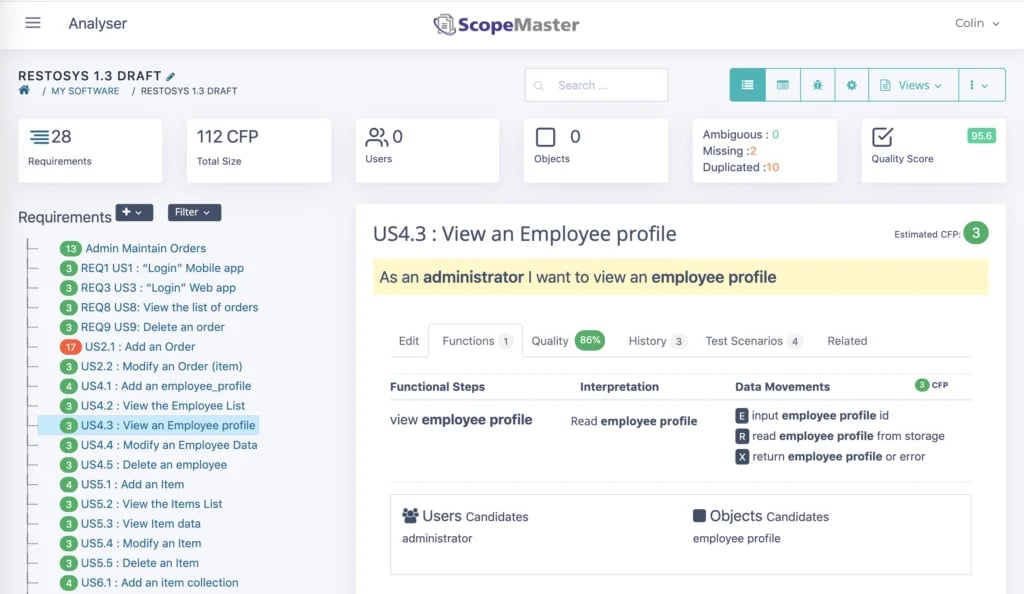
Quality Frameworks: Tools like the Quality User Story (QUS) framework evaluate stories against 13 criteria, such as uniqueness, completeness, and testability. AgileBenchmark uses ScopeMaster technology to measure user story quality as well as measure functional size automatically, which helps to improve estimation and benchmarking.
Metrics Tracking: Monitor rework ratio, defect density linked to requirements, story acceptance rate, and change request frequency. High-quality requirements correlate with lower escaped defects and faster cycle times.
By regularly assessing stories during backlog refinement, teams gain objective insights into requirements health.
The Payoff: Dramatically Better Agile Performance
Investing in requirements quality yields compounding benefits that supercharge agile teams:
Reduced Rework and Costs: Clear stories minimize late changes, cutting rework by substantial margins and freeing resources for innovation.
Boosted Velocity: Teams with refined, ready stories commit more accurately, complete more points per sprint, and see sustained velocity growth. Improvements of 20-30% are common as confusion decreases.
Fewer Defects and Higher Quality: Well-defined acceptance criteria enable better testing, lowering bug rates and improving overall product reliability.
Enhanced Collaboration and Morale: Shared understanding fosters smoother planning, reviews, and demos, reducing friction and boosting team satisfaction.
Faster Time-to-Market: With less backtracking, teams deliver value quicker, aligning closely with customer needs through iterative feedback.
Organizations embracing these practices report transformative outcomes, turning struggling teams into high-performing ones.
Practical Steps to Get Started
Adopt a Definition of Ready: Collaborate as a team to define and enforce DoR criteria.
Invest in Refinement: Allocate regular time for backlog grooming with product owners, developers, and testers (e.g., "3 Amigos" sessions).
Use Quality Checklists: Apply INVEST and tools like ScopeMaster for consistent evaluation.
Track Key Metrics: Monitor rework, velocity trends, and requirements-related defects in retrospectives.
Foster a Quality Culture: Train on effective story writing and celebrate improvements.
Conclusion: Unlock Your Team's True Potential
Bad user stories breed rework and stagnation, but measuring and improving requirements quality unleashes agile's full power. By making this a priority, teams achieve higher velocity, deliver superior products, and thrive in a collaborative environment. Start small—refine your next backlog—and watch performance soar.
AgileBenchmark uses ScopeMaster!
ScopeMaster performs automated Requirements Quality Analysis by leveraging advanced natural language processing (NLP) and multiple layers of intelligent text interpretation to examine textual user stories and requirements. It objectively evaluates quality attributes including clarity, completeness, consistency, unambiguity, testability, and adherence to best practices like INVEST, detecting issues such as ambiguities, inconsistencies, potential duplicates, missing elements, and other defect types—often identifying and suggesting fixes for 30-60% of requirements problems far faster than manual reviews.
At the same time, ScopeMaster conducts fully automated functional size measurement using ISO-standard methodologies, primarily COSMIC Function Points (recommended for its accuracy in agile contexts) and Nesma or IFPUG Function Points, by interpreting the functional intent, detecting data movements (entries, exits, reads, writes), and counting functional processes without manual counting. These results provide actionable insights, enable precise effort estimation, support benchmarking, generate automated positive/negative test scenarios, and help agile teams reduce rework, improve planning accuracy, and deliver higher-quality software more predictably.
Please click here to learn more!